Years of production: 2006 2007 2008 2009 2010 2011
Honda Motor Company is one of the most popular automobile companies in the world. This Japan-based company dominates international motorcycles and car markets in many countries. Honda is a conglomerate corporation that is known to manufacture motorcycles, automobiles, and power equipment. The company was founded in 1948 by Soichiro Honda and Takeo Fujisawa. It's been more than 70 years that the company is in service. Honda has come a long way from the time it was launched in the market. They have a wide range of cars, out of which the Civic range is the most popular one.
Honda Civic VIII: 2006 to 2011
Honda Civic VIII is an eight-generation model that was first manufactured in 2006. The production lasted till 2011. For the eighth generation, the company divided the model into two different platforms. One was made for coupe and sedan and the second was meant for hatchback models which were mainly designed for European markets. In 2006, the company managed to sell around 16.5 million Civics worldwide. The eighth-generation Civic features a very basic design. However, it had a lot of features that made the car even more desirable. Honda Civic VIII was designed for the best comfort and to give you a smooth experience. This car was perfect for budget people. The sleek and aerodynamic design of the car is what made it more attractive. Even the interiors were made of top-notch quality materials.
In the later years, the Civic VIII was redesigned and launched with better and more powerful features. The markers made changes to the steering wheel, suspension, and exhaust system. Honda may produce several other ranges of cars, but the Civic is one of the best range of cars the company ever made. It is currently in the tenth generation.
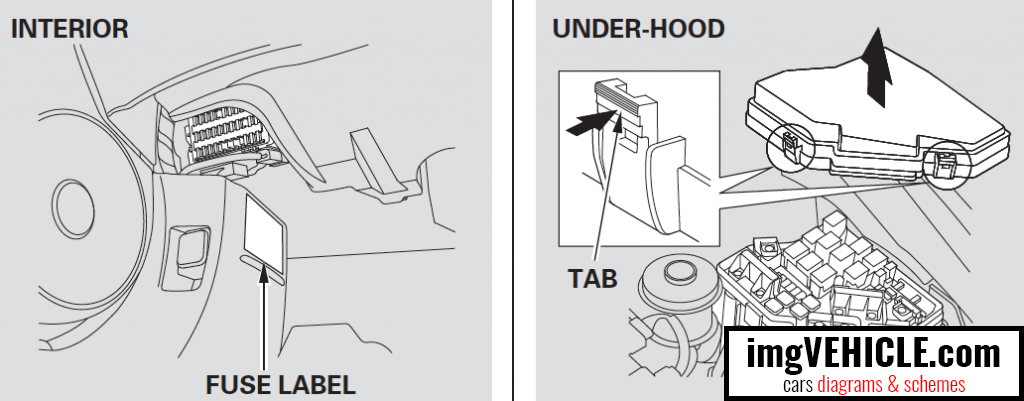
The fuses are in two fuse boxes. The interior fuse box is underneath the steering column. The under-hood fuse box is on the driver's side, next to the brake fluid reservoir. To open it, push the tabs as shown.
Checking and Replacing Fuses
If something electrical in your vehicle stops working, the first thing you should check for is a blown fuse. Determine from the chart on pages 283 and 284, or the diagram on the fuse box lid, which fuse or fuses control that device. Check those fuses first, but check all the fuses before deciding that a blown fuse is the cause. Replace any blown fuses, and check if the device works.
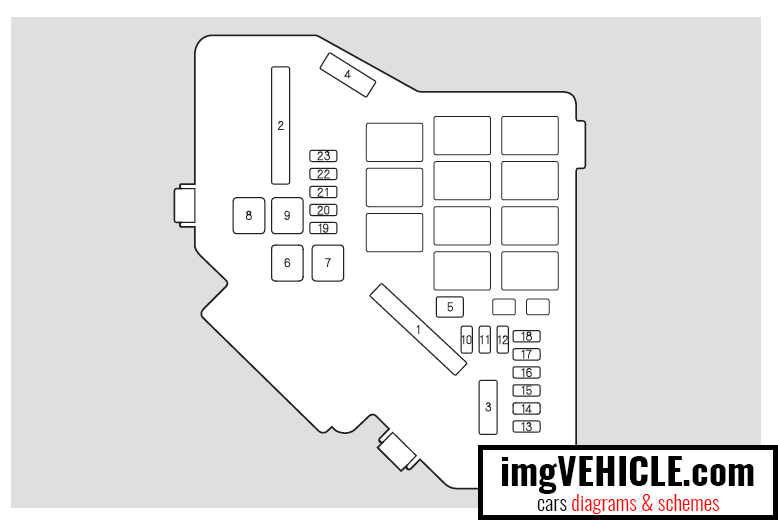
| No. | Amps. | Circuits Protected |
| 1 | 100 A | Main Fuse |
| (70 A) | EPS*1 | |
| 2 | 60 A | Option Main |
| 50 A | Ignition Switch Main | |
| 3 | 30 A | ABS/VSA Motor |
| 30 A, 40 A*2 | ABS/VSA F/S | |
| 4 | 50 A | Headlight Main |
| 40 A | Power Window Main | |
| 5 | - | Not Used |
| 6 | 20 A | Sub Fan Motor |
| 7 | 20 A | Main Fan Motor (M/T) |
| 30 A | Main Fan Motor (A/T) | |
| 8 | 30 A | Rear Defogger |
| 9 | 40 A | Blower |
| 10 | 10 A | Hazard |
| 11 | 15 A | FI Sub |
| 12 | 15 A | Stop and Horn |
| 13 | - | Not Used |
| 14 | - | Not Used |
| 15 | 7.5 A | IGPS Oil Level |
| 16 | - | Not Used |
| 17 | (15 A) | Audio Amp*1 |
| 18 | 15 A | IG Coil |
| 19 | 15 A | FI Main |
| 20 | 7.5 A | MG Clutch |
| 21 | 15 A | DBW |
| 22 | 7.5 A | Interior Light |
| 23 | 10 A | Back Up |
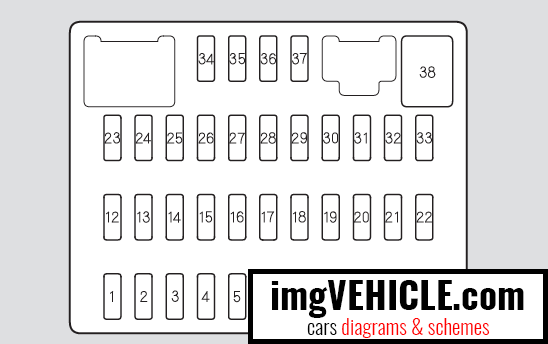
| No. | Amps. | Circuits Protected |
| 1 | 7.5 A | Power Window |
| 2 | 15 A | Fuel Pump |
| 3 | 10 A | Alternator |
| 4 | 7.5 A | ABS/VSA |
| 5 | (15 A) | Heated Seat* |
| 6 | - | Not Used |
| 7 | (7.5 A) | TPMS* |
| 8 | - | Not Used |
| 9 | 7.5 A | ODS |
| 10 | 7.5 A | METER |
| 11 | 10 A | SRS |
| 12 | 10 A | Right Headlight High |
| 13 | 10 A | Left Headlight High |
| 14 | 7.5 A | Small (Interior) |
| 15 | 7.5 A | Small (Exterior) |
| 16 | 10 A | Right Headlight Low |
| 17 | 10 A | Left Headlight Low |
| 18 | 20 A | Headlight High Main |
| 19 | 15 A | Small (Main) |
| 20 | - | Not Used |
| 21 | 20 A | Headlight Low Main |
| 22 | - | Not Used |
| 23 | - | Not Used |
| 24 | (20 A) | Moonroof* |
| 25 | 20 A | Door Lock |
| 26 | 20 A | Driver's Power Window |
| 27 | - | Not Used |
| 28 | (15 A) | Rear ACC Socket* |
| 29 | 15 A | ACC |
| 30 | 20 A | Passenger's Power Window |
| 31 | - | Not Used |
| 32 | 20 A | Right Rear Power Window |
| 33 | 20 A | Left Rear Power Window |
| 34 | - | Not Used |
| 35 | 7.5 A | ACC Radio |
| 36 | 10 A | HAC |
| 37 | 7.5 A | Daytime Running Light |
| 38 | 30 A | Front Wiper |
* if equipped
If you cannot drive the vehicle without fixing the problem, and you do not have a spare fuse, take a fuse of the same rating or a lower rating from one of the other circuits. Make sure you can do without that circuit temporarily (such as the accessory power socket or radio). If you replace the blown fuse with a spare fuse that has a lower rating, it might blow out again. This does not indicate anything wrong. Replace the fuse with one of the correct rating as soon as you can.
All Honda Civic VIII info & diagrams provided on this site are provided for general information purpose only. Actual Honda Civic VIII (2006-2011) diagrams & schemes (fuse box diagrams & layouts, location diagrams, wiring diagrams etc.) may vary depend on the model version.
~Aaron herr 07-02-2021
Where is the evap selenoid fuse untie fuse box?
~WALDEMAR SOLIS 19-11-2021
EXCELENTE, MANUAL
Add comment
Source: https://imgvehicle.com/honda/civic-viii/fuse-box
Posted by: billyfronnessaeo.blogspot.com

Posting Komentar